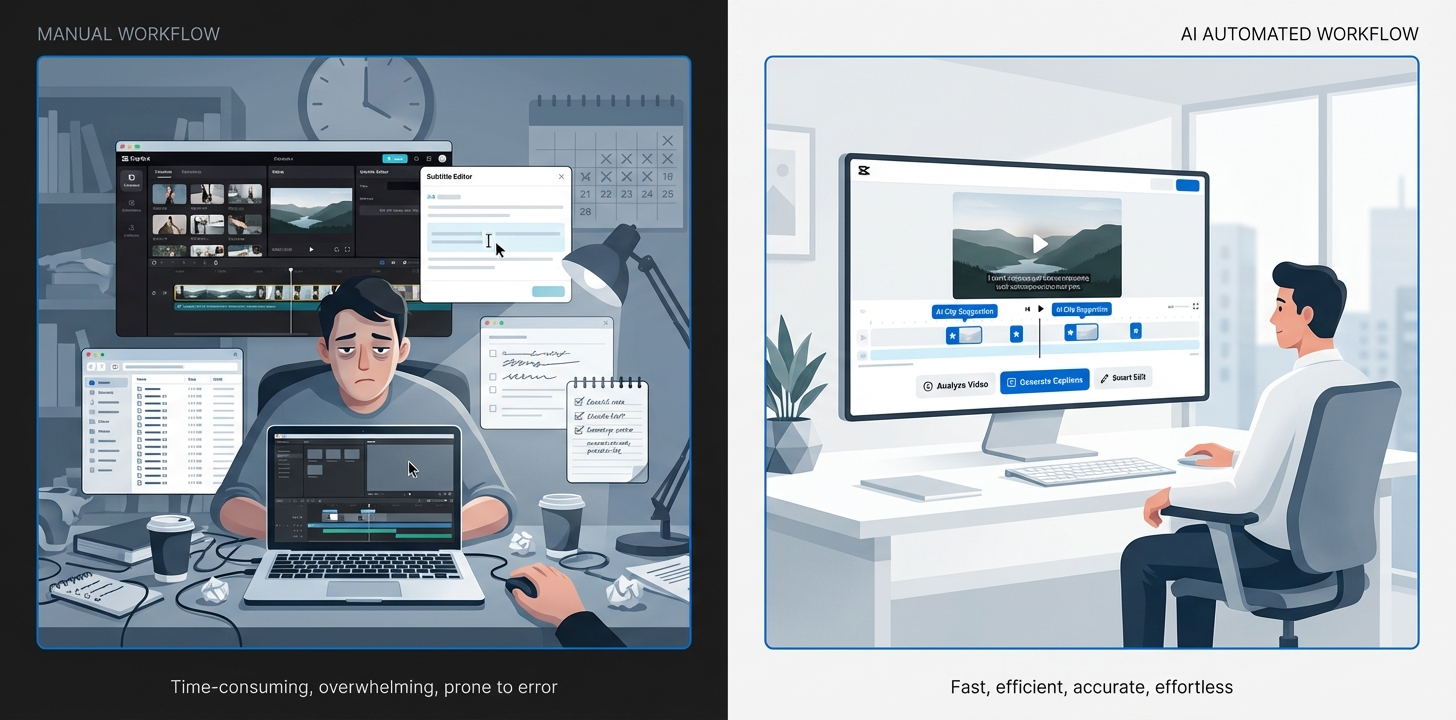
Manual vs. Automated Social Clips: The Real Cost of Doing It the Hard Way
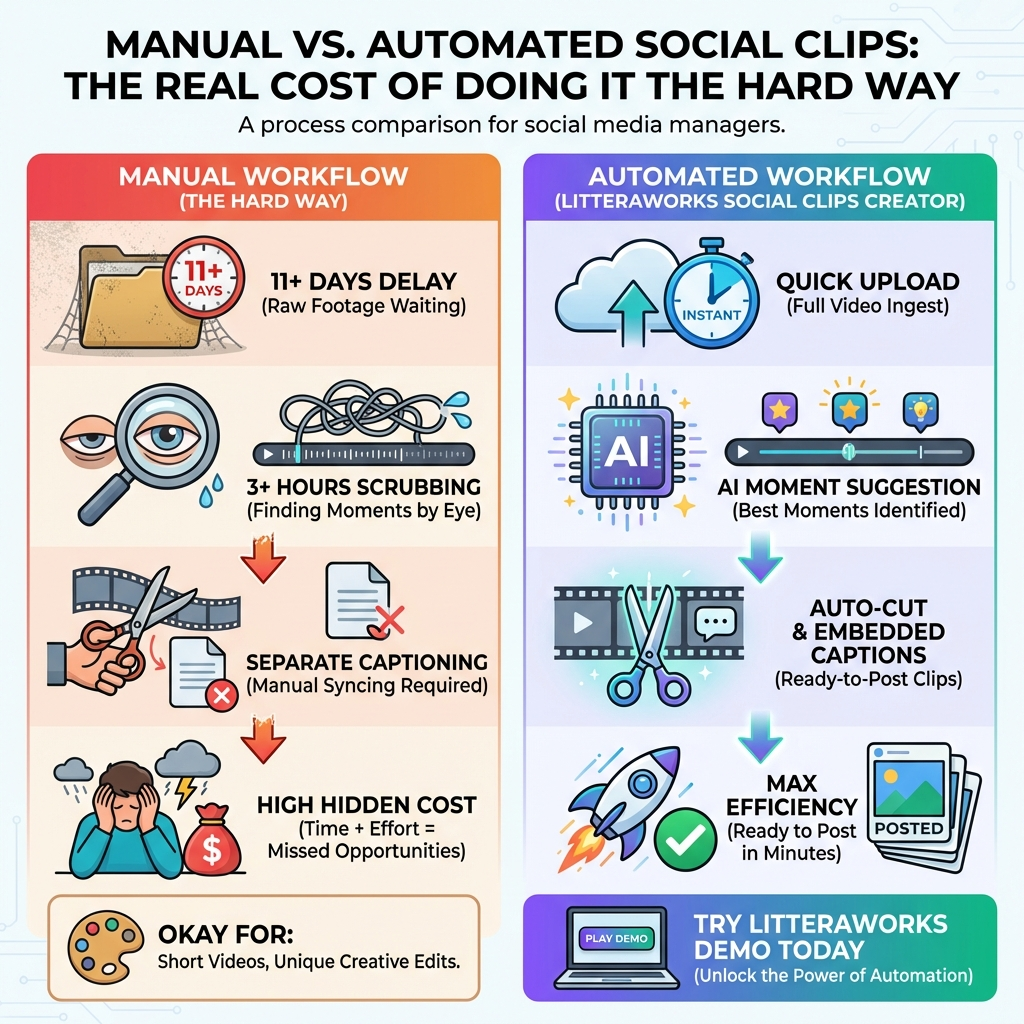
There is a folder on your shared drive right now. It is labeled something like "Raw Footage - Q2 Conference" and it has been sitting there for eleven days. Everyone on the team knows it contains at least five clips worth posting. Nobody has touched it. Not because the team is lazy, but because watching three hours of conference footage to find those five moments is a job nobody can justify scheduling.
That folder is not a storage problem. It is a workflow diagnosis.
The Hidden Cost Nobody Budgets For: Discovery Time
Here is the reframe that changes how this problem looks: editing a 30-second clip takes minutes. Identifying which 30 seconds to clip from a 3-hour recording takes hours. Those are not the same problem.
Review time is invisible on most project trackers. Teams absorb it as a background cost, which makes it easy to dismiss as "just part of the process" - but it consumes the bandwidth of the people who are most expensive to waste. According to Wyzowl's 2026 Video Survey, manual video editing for social media takes an average of 4.5 hours per finished minute of content. For a 30-second social clip, that is a significant investment before a single frame is cut.
The content value locked inside unreviewed footage is not abstract. Short-form videos under 60 seconds carry a 50% average engagement rate, per Wistia's 2025 State of Video research. Every week a conference recording sits unwatched is a week of high-performing content compounding nothing.
According to HubSpot's State of Marketing 2026, the opportunity cost of manual clipping results in a 40% decrease in posting frequency for small tech teams. Not because teams lack content - but because discovery time makes consistent output operationally impossible without headcount most small teams do not have.
The Manual Workflow: Where the Hours Actually Go
Walk through the actual steps.
Load and scrub. Open the raw file and begin watching at 1.5-2x speed, pausing to mark potential moments. For a 3-hour recording, this alone takes 90 minutes or more. Scrubbing is not linear - you overshoot timestamps, rewind, lose your place.
Judgment calls under time pressure. A good quote mid-panel might land flat without the setup 45 seconds earlier. One interesting 20-second window can cost several minutes of back-and-forth rewatching.
Manual crop, captions, and repeat. Resizing from 16:9 to 9:16 requires manual keyframing or a separate tool. Animated captions for social require another export step. Then repeat per clip, per platform, per language. One source video, five clips, three languages, two aspect ratios: that is not a workflow. That is a project.
For a single short interview, this workflow is manageable. The problem surfaces when volume increases, events happen weekly, or multilingual distribution is part of the brief.
The Automated Pipeline with LitteraWorks: What Changes
The shift to a pipeline-first approach is not about making editing faster. It is about removing the discovery phase entirely. LitteraWorks is built specifically around the bottleneck described above.
Upload the full video. LitteraWorks ingests the complete recording. A 2h50m video is processed in under 25 minutes. The footage-scrubbing phase that would take a human 90+ minutes at 2x speed is handled before a second coffee.
AI surfaces 2-10 ranked clip candidates. The platform identifies clip-worthy moments and assigns each a virality score, giving the editor a prioritized shortlist rather than a blank timeline. The AI does not make the final call - the editor still reviews, approves, and applies brand judgment. Human control is preserved where it matters.
Vertical crop, captions, and transcription in one step. Dynamic speaker-tracking crops footage to 9:16 automatically. Animated karaoke-style captions are generated and burned in as part of the same pipeline - not a separate workstream. The same transcription that powers clip candidates also feeds article drafts and translations across 40+ languages from a single ingestion. Teams serving multilingual audiences are not running separate processes per language. One input generates multiple outputs across formats in a single pass.
This is where the clip stack concept pays off: instead of one clip emerging from hours of manual review, a ranked, captioned, cropped clip stack is ready for editorial review before the team has finished their morning standup.
Side-by-Side: Where Each Workflow Wins
| Dimension | Manual | LitteraWorks Pipeline |
|---|---|---|
| Discovery speed | 60-90+ min for a 3-hour source file | Under 25 minutes for a near-3-hour file |
| Subtitle workflow | Correction passes; burned-in captions need extra export steps | Animated captions generated in the same pipeline step |
| Multi-language output | Separate tool chains per language | 40+ languages from a single transcription |
| Editorial control | Granular throughout | Preserved at approval stage; pre-editorial labor automated |
Manual editing wins for low-volume production - one or two clips per month - or for highly stylized creative work requiring custom motion graphics. For teams processing multiple long-form videos per week and carrying the opportunity cost of staff scrubbing footage instead of doing higher-judgment work, the math on manual does not hold.
Forrester Research has found that automated clipping tools reduce production costs by up to 85% for enterprise marketing teams. Small teams do not have enterprise budgets, which makes the efficiency argument even more pointed.
Consistency Is the Growth Variable Your Workflow Must Protect
Algorithmic platforms do not reward the best clip. They reward the most recent one that meets a quality threshold. A perfectly edited clip posted two weeks after a conference underperforms a good-enough clip posted the day after - not because the quality is worse, but because the recency signal is gone.
Sprout Social reports that short-form video content generates 2.5x more engagement than long-form in the technology sector. But that number only pays out if the clips are published consistently - on a schedule that does not depend on someone having a free afternoon to scrub footage.
Fixing your editing tools addresses the last 20% of the problem. Fixing your discovery and ingestion pipeline - the ability to repurpose long-form recordings into a ready-to-review clip stack with captions and transcription already complete - addresses the first 80%.
If your team has footage sitting in a folder right now that has not been clipped because nobody has the hours to review it, that is the exact problem LitteraWorks was built to solve. Request a demo to see the Social Clips Creator process a real video from your library.